Letters to the Editor — First Public Advocacy
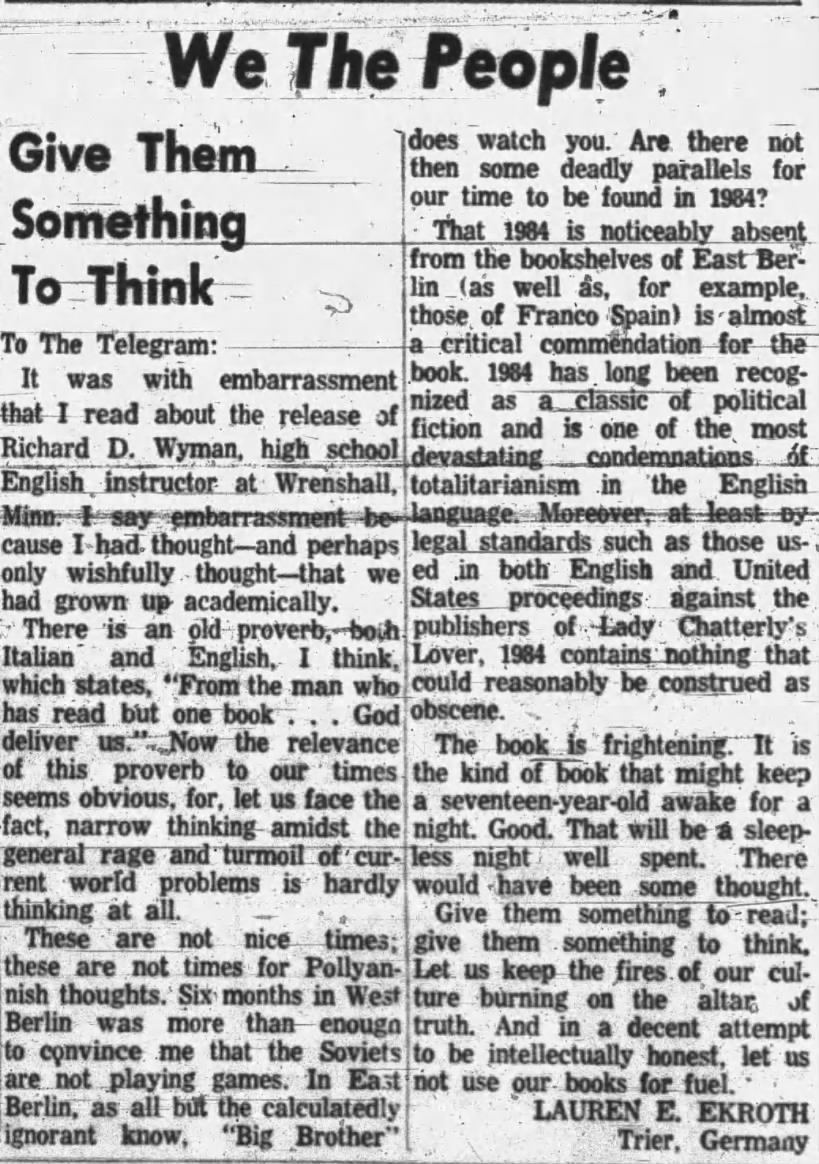
The earliest known published writing by Loren Ekroth is a letter to the editor of the Evening Telegram, dateline Bitburg, Germany, printed October 31, 1961. He was writing in defense of Richard D. Wyman, a high school English instructor at Wrenshall, Minnesota, who had apparently been dismissed for assigning controversial books. Ekroth invoked his recent experience: “Six months in West Berlin was more than enough to convince me that the Soviets are not playing games. In West Berlin, as all but the calculatedly ignorant know, ‘Big Brother’ does watch you.” He drew parallels between the absence of Orwell’s 1984 from East Berlin bookshelves and the censoring impulse he saw at home, and defended D. H. Lawrence’s Lady Chatterley’s Lover on legal and literary grounds. The letter closed: “Give them something to read; let us keep the fires of our culture burning on the altar of truth.” The voice was earnest, impassioned, and grounded in firsthand Cold War observation. At twenty-six, writing home from a military base in Germany, his instinct was to argue in public for the freedom to think.
Four years later, in July 1965, he published a second letter — this time in the Star Tribune of Minneapolis, a major-market daily, under his Minneapolis byline. The cause was the same (intellectual freedom; Commissioner Milton Rosen had moved to remove certain books from Minneapolis-St. Paul International Airport), but the voice had transformed entirely. The letter is satirical: “Happily, the public morality is still carefully protected. Until Commissioner Milton Rosen moved to have certain books removed from sale at our international airport, I had suffered from nagging visions of Aunt Maude, on her way to Fargo, sneaking a peek at ‘Sexus’; or some bon vivant, on his way to a Paris vacation, muddying his mind with the cleverly concealed obscenities of ‘Fanny Hill’.” Not a word is sincere in surface meaning; the entire argument is delivered through the absurdity of the scenarios. The 1961 Ekroth was urgent and earnest; the 1965 Ekroth was dryly funny and technically precise — citing the three books (Henry Miller’s Sexus, John Cleland’s Fanny Hill, Terry Southern’s Candy) at the center of the American censorship debate that year.
Taken together, the two letters establish the writer who predated the newsletter editor: same conviction, evolving craft. The man who would eventually publish 720 essays on how people communicate had his first bylines in the letters columns of Wisconsin and Minnesota newspapers, defending the right to read and think freely.
- 1961 publication
- Evening Telegram, Superior, Wisconsin
- 1961 byline location
- Bitburg, Germany
- 1965 publication
- Star Tribune, Minneapolis, Minnesota
- 1965 byline location
- Minneapolis
- Cause
- Intellectual freedom, anti-censorship
- 1961 subject
- Defense of a fired English teacher; Orwell's 1984, Lady Chatterley's Lover
- 1965 subject
- Airport book censorship (satire); Sexus, Fanny Hill, Candy