Kama'aina Fundraisers

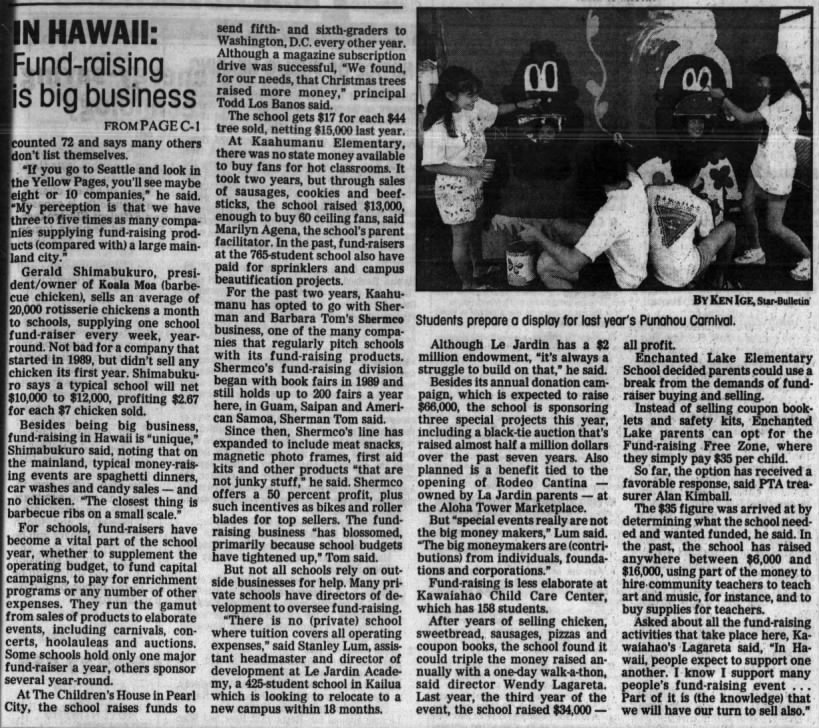
By October 1994, Lauren Ekroth was three years into running Kama’aina Fundraisers, a small business he had started around 1991 after retiring from the University of Hawaii. The Honolulu Star-Bulletin’s feature on the fundraising industry in Hawaii quoted him as an expert on the local market, describing him as a “retired University of Hawaii speech professor.” He supplied coupon books, beef jerky, and beef sticks to six to eight schools a year, as well as to other groups, on a 50-percent profit model with incentives for students and staff. He devoted two-thirds of his time to the business, which he called “a fairly profitable business.”
Ekroth offered a characteristically analytical take on the industry: “I believe the islands of Hawaii are probably the fund-raising capital of the states.” He explained the underlying logic — Hawaii’s geographic isolation meant that schools and teams needed far more money to travel to mainland competitions than their counterparts anywhere else. “Whenever a team wins a regional championship or when a school band wants to participate in the Rose Bowl parade, they’ve got to raise a whole lot of money to get to the mainland,” he said. He had counted 72 fundraising companies listed in the Honolulu Yellow Pages that year, up from fewer than 50 in 1991, estimating that Hawaii had three to five times the density of such companies as a comparable mainland city.
Kama’aina — the Hawaiian word for a long-time resident of the islands, literally “child of the land” — reflected his 27-year relationship with Hawaii since arriving at UH in 1967. The business appears alongside the Natural Learning Center of Hawaii in his later professional biography, the two enterprises representing the practical and personal-development sides of his post-academic career.
- Age
- 59
- Title
- Retired University of Hawaii speech professor
- Business
- Kama'aina Fundraisers
- Founded
- ~1991
- Second business
- Loren Ekroth & Associates
- Products
- Coupon books, beef jerky, beef sticks
- Clients
- Six to eight schools per year, plus other groups
- Profit model
- 50 percent profit and incentives to students and staff